

Originally published by Robert Gottliebsen of The Australian
07.04.2026
The NSW and Victorian renewables plan is set to be the biggest financial disaster since Federation.
The original financial estimates on which the decision to proceed was made were total fiction and completely underestimated the complexity and cost of the project.
Back in 2020, the AEMO cost estimate for most of the transmission line projects was just $8.5bn. Renewables looked to be low-cost and very profitable.
Now the transmission lines will cost at least $120bn but, as explained below, are more likely to explode beyond $200bn. Add another $160bn for the wind and solar generators and we have a $350bn-plus project that is being financed with high-cost loans, which could boost the total 35-year outlay above $1 trillion.
Australia’s current debt is around $940bn.
The enormous burden this sickening disaster puts on the nation means if we proceed, we can no longer consider reacting to the impacts of the Iran crisis aiming to make the nation far more independent with additional oil refineries, key manufacturing industries and other proposals that are becoming essential for Australia’s future.
The government could argue that the funding for renewables is not really borrowings because it will be met by the consumers of power over 35 years.
But that would send power costs through the roof and make Australia an uneconomic destination for most activities.
Those currently bemoaning the cost of living are now set for a continuation of the disaster for at least three decades.
The designers of the chaos appear to delight in running their thousands of kilometres of cables and thousands of towers — that are about the height of Sydney Harbour Bridge pylons — through our best agricultural land.
The nation can be very grateful to our wonderful farmers, who might not have understood the financial disaster they were delaying, but they knew they were acting in the national interest to protect our agricultural industry.
The combination of their actions and the chaos created by lack of proper planning means that outlays so far appear to have been restricted to not much more than $10bn. We can avoid a nation-crushing disaster.
Earlier this week the ALP moved to remove its emissions target from its national policy — the first sign that some in the ALP have woken up to the fact that Energy Minister Chris Bowen has created a financial nightmare.
To their great credit, the Liberals, Nationals and One Nation are all now opposed to putting towers on agricultural land.
One Nation goes one step further and states that where towers are being put on agricultural land, developers must put the required money aside to pull the towers down. Until this commentary, none of the three political parties knew the extent of the disaster.
Accordingly, both the Coalition and Nationals should immediately match the One Nation policy on money being set aside by developers to pull the towers down. All three parties need to go further and demand that the scheme be halted immediately.
There is currently $335bn in the Future Fund, which was set up to fund public servant retirement pensions.
Dangerously, it has been empowered to invest in the renewables money pit.
Already the Future Fund has taken equity positions in developer Transgrid, effectively helping to bail out the mess. They must stop immediately.
To make the calculations I needed a person with far more knowledge of the detail of the project and the mathematics involved.
I collaborated with Aidan Morrison of the Centre for Independent Studies.
In long conversations, we worked together on the calculations, but the above conclusions are mine.
Until we obtained detailed up-to-date cost sums on recent projects, it was impossible to calculate the overall costs because the original figures were total fiction.
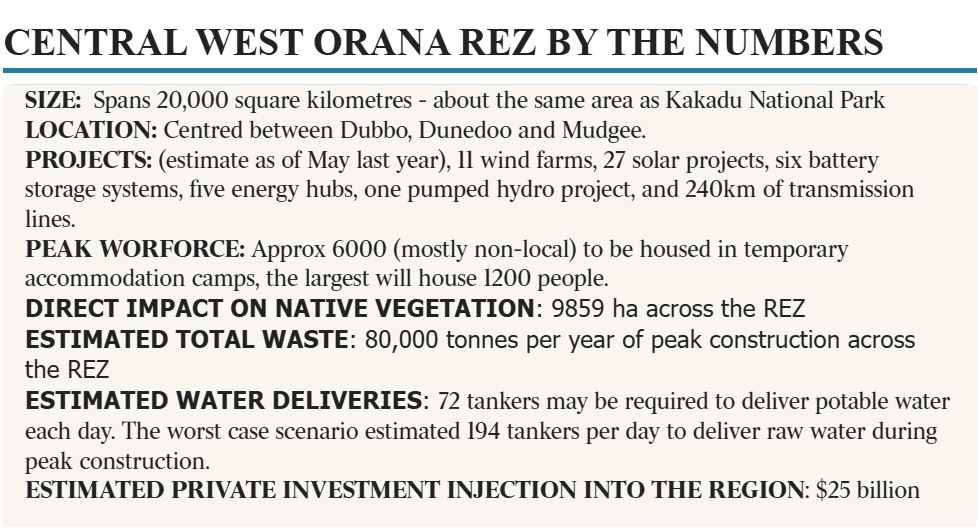
The Central West Orana (CWO) Renewable Energy Zone (REZ) project in western NSW has released proper designs and costings, so we now have a guide for all the other transmission projects.
But we also now have a virtually completed transmission project which shows the final costs may be substantially more than those indicated by the CWO designs.
Nevertheless, the CWO REZ engineering design can be used as a guide to the costs of other renewable energy zones because there is no other REZ that has reached this level of maturity. CWO has declared a total cost of $5.5bn, compared to an initial estimate of $675m. But construction has only just started.
By contrast, Project EnergyConnect is almost completed. It was the first project to be advanced for the specific purpose of allowing greater renewable energy sharing between NSW and South Australia. It got regulatory approval for a fully developed and detailed design at $2.3bn — a duplication of what CWO has achieved.
However, the final construction cost is now $4.1bn, which is an 80 per cent increase.
Given the recent enormous rise in the cost of building and the unforeseen additions and complexities that will arise, CWO’s construction cost may also rise 80 per cent above design.
If the design-based capital costs of connecting renewables via a long string of Renewable Energy Zones along a 2000km 500kV corridor between and around Sydney and Melbourne are similar to the CWO first 90km, then the total design-based cost of the renewable transmission plan will be around $120bn. But if the Project EnergyConnect building experience is duplicated, the cost rises to $215bn.
When it comes to the generators, we use the CSIRO estimate that the cost of the 60GW of wind and solar power generators that are forecast to be added in NSW and Victoria (plus batteries) will be almost $160bn.
The design-based CWO costs plus the CSIRO generator cost produce a total cost estimate for the project at $280bn. If we add 80 per cent to the CWO transmission design cost, the total cost is $375bn.
The Central West Orana helps in the finance costings.
The NSW government went to market to try to find an attractive bid. Market rumours suggest that because of the construction risk they had to pay close to 10 per cent, but to be conservative we will assume eight per cent.
If a transmission project was paid off like a home mortgage over the course of 35 years (the period that the Central West Orana contract is for), then the interest costs are double the initial principal amount. So on the conservative total construction cost of $280bn, we have a total outlay of $840bn. Inflate transmission construction costs and the outlay exceeds $1.1 trillion. The mid-line is very close to $1 trillion.
Snowy 2.0 is coming in at 20 times the original cost estimate and the wider project is similar. The Australian public was duped when told that our renewables scheme would provide cheap power. That might be right using some other system, but not the one Australia embraced.